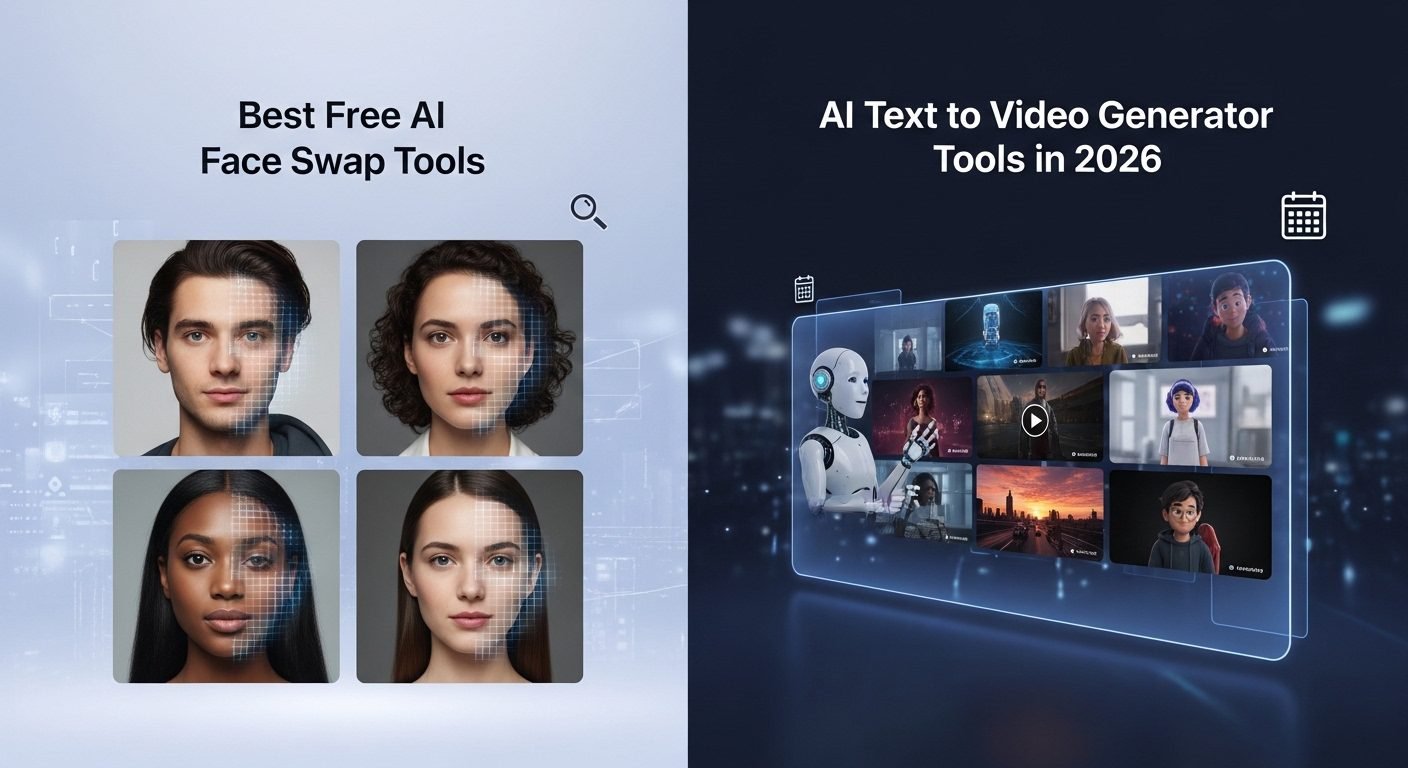

In case you want to know the best free AI face swap and AI text to video generator tools in 2026 here is the terse answer, after trying dozens of sites, you can easily see that there are few really fast, really realistic, and ready to produce sites, and at the forefront is Magic Hour.
Two weeks of practical experimentation with real producer processes (short-form content, ad creatives, talking avatars, and meme formats) have reduced it to a small list of the tools which actually work – not merely demo well.
At least one of these tools will be a perfect fit to your workflow at a glance.
Most used Tools: Best Tools at a Glance
| Tool | Best For | Modalities | Platforms | Free Plan | Standout Feature |
| Magic Hour | All-in-one creators & teams | Face swap, text-to-video, lip sync, image-to-video | Web | Yes (generous) | Parallel generations + multi-step workflows |
| Runway | Filmmakers, creatives | Text-to-video, video editing | Web | Limited | High-end cinematic generation |
| Pika | Quick social content | Text-to-video | Web/Discord | Yes | Fast iterations |
| HeyGen | Talking avatars | AI avatars, lip sync | Web | Limited | Business-ready avatar generation |
| Synthesia | Corporate training videos | AI presenters | Web | No free (trial only) | Enterprise video workflows |
| DeepSwap | Face swap focused | Face swap | Web | Paid-focused | High realism for static swaps |
| Kapwing AI | Marketers & editors | Text-to-video, editing | Web | Yes | Simple UI + editing suite |
| D-ID | Talking photos | Face animation | Web/API | Limited | Realistic talking images |
1. Magic Hour
The only site that I tried and which felt like a full-fledged AI content studio and not a one-feature application is Magic Hour.
It merges the face swap, lip sync, image-to-video and text-to-video processes all into a single system- and more importantly, it does it without rubbing.
Their free AI face swap is always free.
Pros:
Best-in-class face swap realism (angles, lighting, expressions)
Complete text to video full AI generator with templates.
One-clicks (create pipelines: generate, upscale, animate)
Parallel generations (not on a queue)
Credits never expire
Very generous free plan.
Does not have problems with desktop or mobile.
Weekly feature updates
Cross tool API access.
Cons:
workflows Advanced workflows can be initially intimidating.
No: Credit system: needs to be understood to use heavily.
My Take:
This was the only tool which after testing I did not experience being restricted despite having a number of rules predetermined.
This is difficult to beat if what you desire is speed + flexibility + output that is production ready.
The actual distinction lies in the ease with which you are able to transition between concept to completed work- without having to switch instruments.
You can, e.g:
Generate an image
Convert it into video.
Add lip sync
Export variations
All in one place.
Their AI text to video generator workflows can also be tried out at the link below:
Pricing:
Free plan available
Creator: 15/month (10/month per year)
Pro: $39/month (25/month annually)
2. Runway
Runway is among the latest and the most developed tools of generating AI video on the big screen.
It is popular amongst filmmakers and creative departments taking AI-generated images to the limit.
Pros:
High-quality video outputs
Strong text-to-video capabilities
Advanced editing tools
Frequent model updates
Cons:
Not inexpensive to use in regular use.
Slowness in the rendering, relative to competitors.
Non-creatives Learning curve LC
My Take:
Runway is strong-but not necessarily efficient to speedy-paced creators.
It is a powerful choice, assuming you are not in a hurry, but want to display images well.
Pricing:
Limited free credits
6 Paid plans begin at around $15/month.
3. Pika
Pika has been popular due to its speed and usability, particularly amongst the creators of social media.
Pros:
Fast generation times
Easy to use
Suitable to brief content.
Cons:
Output quality varies
Limited customization
Not suitable for complex workflows.
My Take:
Pika is perfect to do some quick experiments although I would not rely on it when it comes to the production that would be consistent.
Pricing:
Free plan available
Paid levels up to increased usage.
4. HeyGen
HeyGen specializes in AI avatars and talking videos, which is why it is used to promote and do business content.
Pros:
High-quality avatars
Strong acting with lips.
Ideal to use in presentations and advertisements.
Cons:
Limited creative flexibility
Less emphasis on entire workflows of video generation.
My Take:
This is fine, in the event that your legislative application is talking head video-s-where–it-is-not a creative ensemble.
Pricing:
Free trial
Paid plans begin at -29/month.
5. Synthesia
Synthesia is designed to operate in creating enterprise video, particularly in training, and internal communication.
Pros:
Professional avatar library
Strong enterprise features
Multi-language support
Cons:
No real free plan
Expensive
Limited creative flexibility
My Take:
It is a business resource – not one which creators or startups trying content out would use.
Pricing:
Starts ~$30/month
6. DeepSwap
DeepSwap is a special face swap application, and it does so.
Pros:
High-quality face swaps
Simple interface
Does well with static pictures.
Cons:
Limited video capabilities
None available wider AI creation capabilities.
My Take:
Viable to niche usage- however not suitable to present day content processes.
Pricing:
Paid-only model
7. Kapwing AI
Combining AI with conventional video editors, Kapwing is easy to use by marketers.
Pros:
Easy-to-use interface
Built-in editing tools
Collaborative features
Cons:
AI is not as developed.
Recent decreased performance on large projects.
My Take:
A robust middle-ground product-but not state of the art AI generation.
Pricing:
Free plan available
Paid plans ~$16/month
8. D-ID
The specialty of D-ID is the conversation about photos and presenters powered by AI.
Pros:
Realistic facial animation
API access
Good for automation
Cons:
Limited creative control
NOT a complete video platform.
My Take:
Most suitable to particular applications such as customer support avatars or learning material.
Pricing:
Free trial
Paid plans available
How I selected these tools.
I did not only superficially go through the features, I tried these tools in practice.
The following are some of the things I considered:
Output quality (face realism, motion consistency)
Speed (generation time, iterations cycles)
User-friendliness (onboarding, user-friendliness of the UI)
Flexibility (is it able to deal with a variety of use cases?)
Pricing value
Scalability (is this team scalable?)
I also tested:
Short-term production of content (Tik Tok / Reels)
Ad creatives
Talking avatars
Meme generation
The majority of the tools in one of these aspects failed.
Market Trends in 2026
Some trends are beginning to be discernible:
1. Whatever you can do on PCs, you can do on your smartphone.
One-factor instruments are being supplanted by multi-modal instruments.
Magic Hour is in the forefront of this change.
2. Rapidity is better than Virtue.
Creators prefer:
Faster iterations
Multiple variations
Rapidly generates goods of a quality acceptable enough.
3. AI Video Insourcing is Turning into a Vario Usability.
By industry standards (e.g., McKinsey AI adoption studies), AI-generated media has been adopted as an ordinary aspect of a digital process.
4. APIs Are Emerging and Becoming Critical.
Developers increasingly need:
Automation
Integration
Scalable pipelines
Final Takeaway
In a hurry? If you have to make a decision:
Best overall Magic Hour.
Best to watch on the Big Screen: Runway.
Most suitable fast social content: Pika.
HeyGen: Best at Avatars.
Synthesia is the best in serving enterprise.
However when it comes to having a single tool to do it all; that is, even being able to free AI face swap and complete AI text to video generator workflows, Magic Hour tops the list.
FAQ
Also, what do you consider to be the favorite free AI face swap tool in the year 2026?
Magic Hour provides the best balance of usability, speed and realism- and has a truly useful free tier.
Which is the most appropriate AI text to video generator?
The most popular are Magic Hour and Runway, yet Magic Hour is more feasible to common creators.
Are Free AI video tools suitable to be used professionally?
Yes—some are. The trick here is to select the tools, which facilitated iteration and scaling, and not only one-off results.
Are such tools technical-based?
The majority of the tools are no-code. Nevertheless, advanced workflows have certain benefits with regard to experimentation.
Is it possible to market AI-generated videos?
Yes–but be sure to check platform policies and copyright issues.
Last tip: do some tests with at least two tools before taking any action. The variation in the speed of the workflow management and quality of the output are more evident when it comes to practice, rather than paper.